Council Asked for an Arborist Report? What You Need to Know – Central Coast NSW
If Council has requested an arborist report for your development, this guide explains what type of report may be required, what an AQF Level 5 consulting arborist assesses, and what to expect during the process.
Aug 27, 2026
Arborist Reports & Development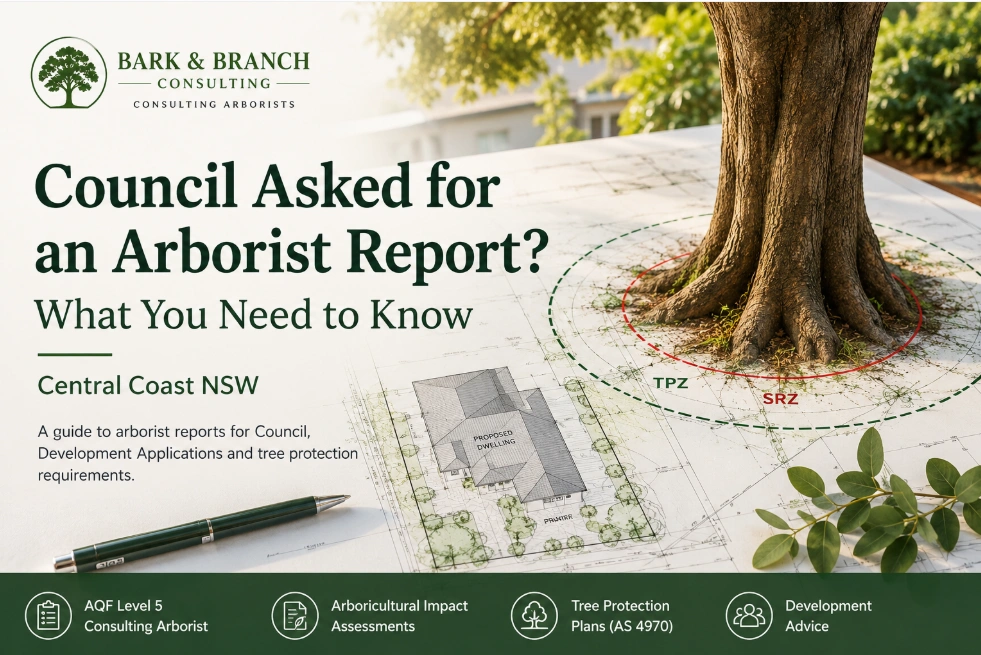
Council Asked for an Arborist Report?
If Council has requested an arborist report as part of a Development Application or planning process, it usually means that existing trees may be affected by the proposed development, or that Council requires further information before the application can be properly assessed.
An arborist report provides Council, the property owner and the project team with professional advice about the trees on or near the site, their retention value, potential development impacts and any measures required to protect trees that are to be retained.
For many development applications, this assessment should be undertaken by a suitably qualified AQF Level 5 consulting arborist.
Why Has Council Asked for an Arborist Report?
Council may request an arborist report where proposed works are located close to existing trees, where trees are proposed for removal, or where development could affect trees located on neighbouring property, Council land or within the road reserve.
The purpose is not simply to determine whether a tree can be removed. A consulting arborist considers how the proposed development interacts with the existing trees and whether appropriate design or construction measures can allow important trees and the development to coexist.
What Type of Arborist Report Do I Need?
The type of report required depends on the stage and nature of the project.
An Arboricultural Impact Assessment (AIA) is commonly required where development plans have already been prepared. It assesses the potential impacts of the proposed development on existing trees and provides recommendations for tree retention, removal and protection.
A Preliminary Arboricultural Report (PAR) can be useful earlier in the design process. It identifies tree constraints before the design is finalised, allowing architects, designers and property owners to consider significant trees when developing the proposal.
Council may also request more specific arboricultural advice, such as a tree risk assessment, tree protection plan, pruning specification or arboricultural supervision.
What Does an Arborist Assess?
Depending on the project, the assessment may include:
tree species, dimensions and location;
health, structural condition and useful life considerations;
retention value;
relevant tree protection requirements;
the relationship between proposed works and tree protection areas;
potential impacts from excavation, construction, driveways, services and other works;
recommendations for tree retention or removal; and
tree protection and construction measures for retained trees.
For development projects, tree protection requirements are considered with reference to the relevant Australian Standards and Council requirements.
What Happens During the Site Inspection?
The arborist will generally inspect the trees relevant to the proposed development and record the information required for the assessment.
The proposed plans and survey information are then reviewed against the tree data. This allows potential conflicts between trees and the proposed development to be identified and assessed.
Where impacts are identified, the arborist can consider whether design modifications, alternative construction techniques or appropriate tree protection measures may reduce those impacts.
Can a Development Proceed if It Encroaches Into a Tree Protection Area?
Not every encroachment automatically means that a tree must be removed or that a development cannot proceed.
The significance of an encroachment depends on several factors, including its extent and location, the condition and characteristics of the tree, existing site conditions and the type of construction proposed.
In some circumstances, appropriate design modifications or less-invasive construction methods can substantially reduce impacts on retained trees.
This is one reason early arboricultural involvement can be valuable. Identifying tree constraints before the design is finalised can help avoid unnecessary redesign, delays and conflicts later in the approval process.
Choosing a Consulting Arborist
Where an arboricultural report is required for a development application, it is important to check Council's requirements regarding the qualifications of the person preparing the report.
Bark & Branch Consulting provides arboricultural assessment and reporting by an AQF Level 5 Consulting Arborist, including Arboricultural Impact Assessments, Preliminary Arboricultural Reports, tree risk assessments and development-related arboricultural advice.
Arborist Reports on the Central Coast
Bark & Branch Consulting provides professional arboricultural reports for homeowners, builders, architects, designers, planners and developers across the Central Coast and surrounding regions.
If Council has requested an arborist report and you are unsure what type of assessment is required, the first step is often simply to provide the Council correspondence together with the available plans or survey. From there, the required arboricultural scope can usually be identified.
Need an Arborist Report?
If Council has requested an arborist report or arboricultural information for your project, contact Bark & Branch Consulting to discuss your requirements and determine the appropriate report or assessment.